gpt-oss 120B GPU requirements and hosting.
The larger gpt-oss reasoning checkpoint. Evaluate it when task quality warrants a larger memory budget, especially for tool-using workflows with verifiable results.
Checkpoint overview.

Model creator
OpenAI- Task in catalog
- Chat / reasoning
- Approx. total parameters (catalog)
- 120B
- Runtime families
- ollama
- Model license
- Apache-2.0 ↗
- Upstream access at review
- No repository access gate reported
- Canonical checkpoint
- openai/gpt-oss-120b ↗
The creator identifies the original checkpoint. Runtime profiles may use separately packaged artifacts; their publishers and configuration can differ. Check the selected profile below.
Configuration matters
Choose a runtime profile.
MoE sparsity reduces active computation, not the need to hold all model weights. Confirm MXFP4 support and runtime overhead before selecting the GPU configuration.
- Catalog GPU threshold
- 80 GB
- Configured context
- 16,384 tokens
- Catalog system RAM
- 128 GB
- Runtime
- ollama
- Artifact identifier
gpt-oss:120b- Precision
- Not pinned in catalog
- Configured concurrency
- 1 request(s)
- Profile inputs / outputs
- text → text
- Deployed artifact revision
- Not verified
Catalog thresholds are configuration guidance, not measured peak memory. A positive GPU requirement is not recorded for every profile; unspecified is not zero. Context, concurrency and runtime overhead can increase memory use. Configured context is a profile setting, not the upstream maximum. Concurrency is configuration, not a load-test result.
Memory components
Account for the whole workload.
ollamagpt-oss:120b
Total GPU allocation Not established
Weights = 120 billion parameters × 2 bytes. This reference does not describe the selected artifact’s unrecorded precision. Cache and runtime reserve need the exact workload. Band widths are schematic, not memory shares; the separate 80 GB catalog threshold is guidance. A multi-GPU total needs a supported model split and topology.
Weight-only arithmetic and a planning estimate
Using the catalog's approximate 120B total parameters, 16-bit weights alone occupy about 240 GB (parameters × 2 bytes). The shared sizing helper rounds a 20% planning reserve to 288 GB.
This arithmetic does not describe the selected quantized artifact. It excludes a workload-specific KV-cache calculation and cannot guarantee fit at the configured context or concurrency. A mixture-of-experts model still stores its full weights.
See the assumptions →Plan the machine.
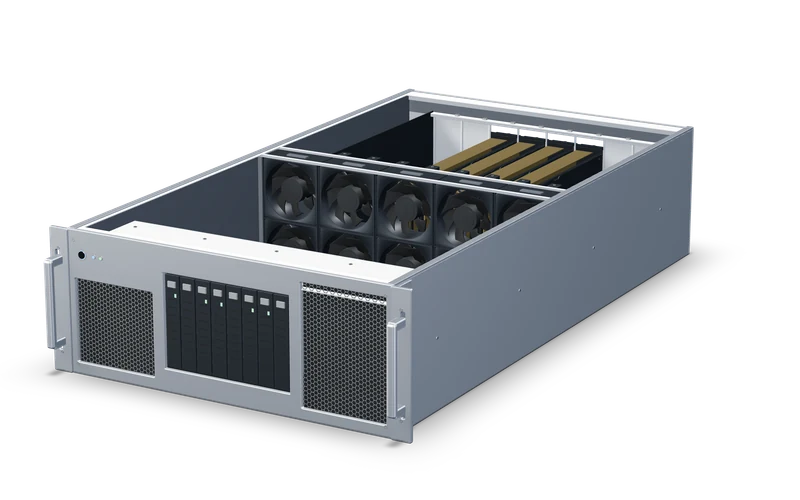
Memory-based machine candidate
4× RTX PRO 6000 Server Edition
384 GB total GPU memory · 96 GB per GPU
80 GB sizing figure · 384 GB installed GPU memory. Per-card placement and interconnect need confirmation.
This configuration includes 512 GB system RAM. Memory capacity alone does not establish runtime compatibility, latency or throughput. Multi-GPU serving needs a supported split and interconnect.
View this configurationCurrent pricing and availability are shown on the machine page.
Before deployment
Test the workload you need.
Measure time to first token and completed-task latency at your chosen reasoning effort. Tokens per second alone can obscure how long the user waits.
These are catalog profiles and planning figures. No B3IQ performance measurement or live capacity is claimed. Confirm the artifact, runtime, workload and machine before deployment.
Evidence available
- Upstream identity / license
- Source reviewed
- Runtime settings
- Catalog configuration
- Memory fit
- Guidance; not a measured peak
- B3IQ performance
- No published benchmark
- Installation / live capacity
- Confirm for your machine
Source and access.
- Upstream checkpoint
- openai/gpt-oss-120b ↗
- Upstream license metadata
- Apache-2.0 ↗
- Access
- No access gate reported by the upstream repository at review.
- Reviewed source revision
b5c939de8f754692c1647ca79fbf85e8c1e70f8a↗
The reviewed revision identifies the source used for this guide. It is not a claim that this revision is installed on a B3IQ machine. Review the publisher's current license and acceptable-use terms for your application.
Guide updates and corrections.
These are changes to the guide. Source-review dates and workload-test evidence are recorded separately.
- · Update
Added creator attribution and a canonical checkpoint overview. The guide now explains how the original creator differs from a runtime artifact publisher.
To report a correction, send the affected claim and a source URL to hello@b3iq.org.
Continue your evaluation.
Compare another checkpoint or explore a complementary task. Each guide explains the workload it is intended for.